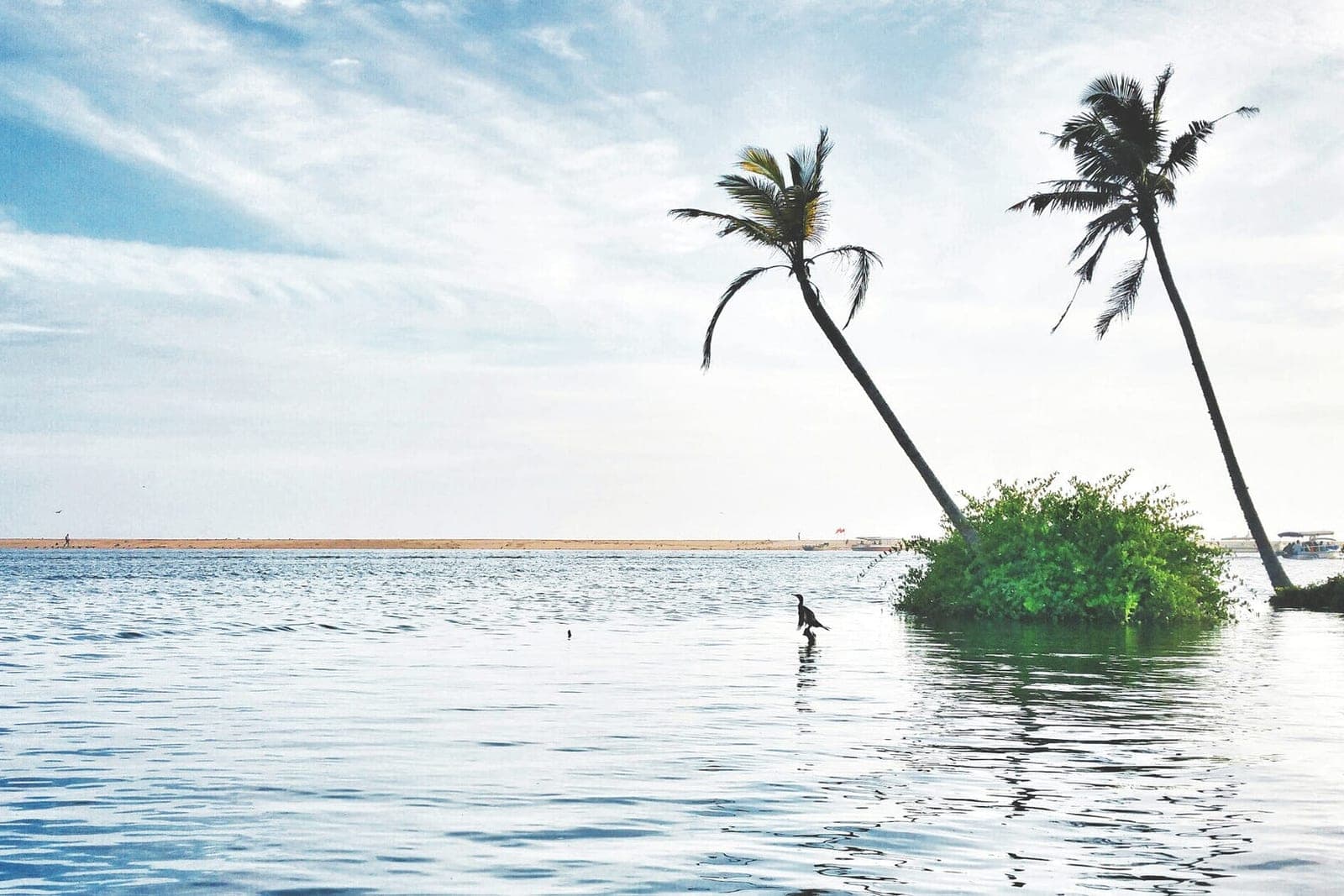
There is a spot near Poovar where you can stand with one foot in river water and the other almost in the sea. The Neyyar river runs down off the Western Ghats, slows into a wide lagoon, and meets the Arabian Sea across a thin golden sandbank. On one side, still backwater; on the other, surf. Most visitors to Kerala never see it, because they turn north for Alleppey and never look south of Trivandrum.
That is exactly why we like it. This Poovar travel guide is for travellers who want the Kerala coast without the crowds — the southern tip, where Thiruvananthapuram, Poovar and Kovalam sit within an hour of each other.
Where the river meets the sea
The headline is the estuary itself. The Poovar backwaters are quieter and narrower than Alleppey's open lakes, lined with mangrove and coconut, and they end at that famous sandbank where freshwater and ocean trade places.
A small boat ride here is the thing to do. You glide past floating cottages and fishing canoes, the boatman cuts the engine near the mouth, and you can usually walk out onto the golden sand for a few minutes before the tide says otherwise. It is the calmest hour of the whole trip.
Note: the boating is optional and charged separately, so factor it in. We think it is the part most people remember, but you are free to skip it and simply sit by the lagoon.
Trivandrum: temple, museum and a sunset beach
The trip opens in the capital, Thiruvananthapuram. Day one is built around the Sree Padmanabhaswamy Temple — a vast Dravidian temple to a reclining Vishnu, and one of the most significant in the country. It is a working temple with a strict dress code, which I will come back to.
From there it is a short hop to a cluster of green, walkable Trivandrum sights: the Napier Museum in its striking red-and-cream building, the Chitra Art Gallery, and the city zoo, all set in the same leafy grounds.
We close the day at Shanghumugham Beach for sunset — a long, flat stretch where local families gather and the light goes copper over the water. It is an evening stroll, not a swimming beach, and it is all the better for it.
Kovalam and the Azhimala cliffs
Day two ends at Kovalam Beach, the crescent below the red-and-white Lighthouse, in time for golden hour. Kovalam is the busier, more familiar face of this coast — shacks, surf and the lighthouse you can climb — but late afternoon, with the day-trippers thinning out, is the right time to be there.
On the final morning we drive to Azhimala Shiva Temple, where a towering Shiva statue stands on the cliffs above the Arabian Sea. The walk down to the rocks, with waves breaking below the figure, is one of the most dramatic viewpoints on the southern coast — and far less photographed than it deserves.
How the trip runs and where it starts
This is a short, well-paced break: two nights and three days, on our Poovar Paradise Escape. We pick you up at Trivandrum — the ex-point — put you in a well-rated 3-star hotel with daily breakfast, and run everything in comfortable private transport, so there is no juggling buses between the temple, the backwaters and the beaches.
It pairs neatly with a longer Kerala plan. If you are doing the classic northern backwaters too, read our Alleppey houseboat guide — Poovar makes a lovely, slower bookend to that trip.
Best time to visit
Aim for October to March. The post-monsoon months are dry, the sea is calmer for boating, and the heat is manageable for temple visits and beach walks. December and January are the most comfortable.
The southwest monsoon arrives around June and the rain is heavy through to September — the backwaters look lush, but boat rides and beach time get unreliable. April and May are simply hot and humid.
What to budget for, and a temple-dress note
The package covers your hotel, breakfast, all transfers and the sightseeing drives. A few things sit outside it, so plan ahead:
- Boating and entry tickets — the Poovar cruise, museum and temple entries are paid on the day.
- Lunch and dinner — only breakfast is included; seek out the local seafood and Kerala thalis.
- Flights or trains to Trivandrum — these reach the ex-point but are not part of the package.
On dress code: Padmanabhaswamy is strict. Men are traditionally required to wear a mundu (dhoti) with no shirt, and women a saree or a long skirt and blouse — trousers and Western wear are not permitted inside. You can hire or buy a mundu at the entrance. Even at the more relaxed temples, cover shoulders and knees, and be ready to leave footwear (and often phones and cameras) outside.
Alleppey is where everyone goes; Poovar is where the river actually meets the sea. Come for the sandbank, stay for how few other people found it.
Who it suits
This break is ideal if you want Kerala's coast at a gentle pace — temples, museums, two beaches and a backwater cruise, all without long drives. It suits first-time visitors to the south, couples after a quiet few days, and anyone who has already done Alleppey and wants something less trodden. It is, frankly, a soft and romantic itinerary too, in the spirit of our honeymoon destinations guide.
It is not a party or a long-haul adventure trip, and the beaches here are for strolling and sunset rather than serious swimming. If your idea of Kerala is a week of trekking the high ranges, this is not that — but as a coastal, culture-and-calm escape from Trivandrum, very little beats it.
Ready to plan your trip?
Let our travel experts create the perfect itinerary for you.